“We are in the continent of consensus on the diagnosis, but not on the solutions”

Simon Colboc
FECIF Secretary-General

Europe Saves.
Europe Fails to Invest.
The Difference is Advice.
by Simon Colboc, FECIF's Secretary-General
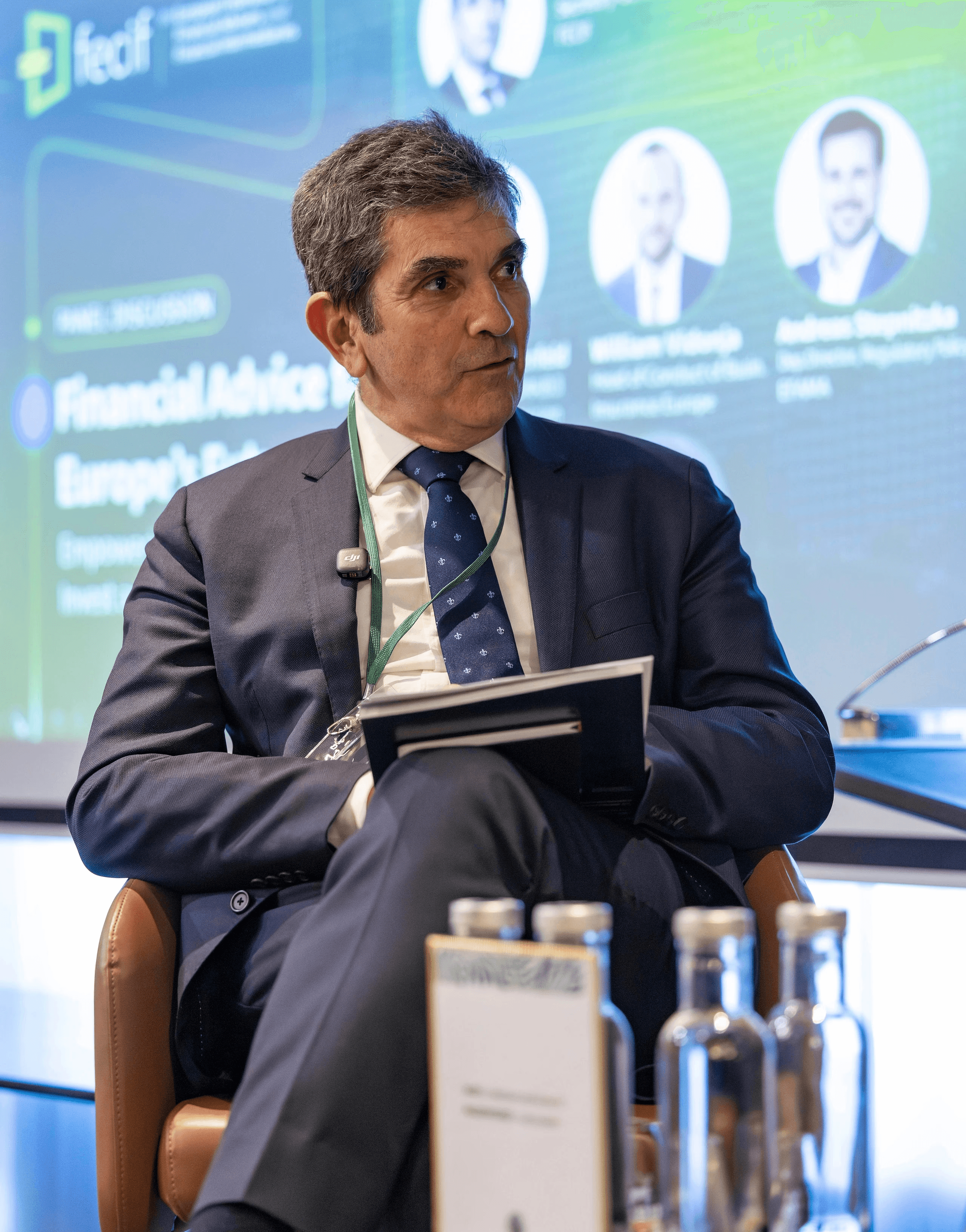
There is a particular kind of policy frustration that comes not from ignorance but from inaction — when everyone in the room agrees on the problem, the evidence is overwhelming, and still nothing moves. On the evening of 21 April, FECIF gathered in Brussels senior representatives from across the European financial services landscape, in an event chaired by chairperson Vania Franceschelli and facilitated by Secretary-General Simon Colboc. All panelists agreed on the diagnosis with striking consistency. Whether Europe can agree on the cure is a rather more open question.
The diagnosis, to be plain, is this. European households save. They save well and they save consistently. What they conspicuously fail to do is invest. A disproportionate share of accumulated wealth sits in deposits and low-yield instruments, inert and unproductive, generating neither adequate returns for savers nor the capital flows that a continent in the midst of digital and environmental transitions urgently needs.
What Advice Actually Does
William Vidonja of Insurance Europe set the terms of the debate early. Saving, he noted, is only half the equation. The real question is how to ensure that part of those savings finds its way into productive investment — serving individual financial goals and broader economic growth simultaneously. The evidence is unambiguous: individuals who receive professional guidance build more wealth, prepare more effectively for retirement, and approach financial decisions with measurably greater confidence. As the discussion made plain, "financial advice is not just a service. It's a key driver of economic participation."
Jacopo Borgognone of the European Banking Federation added the macro dimension. The core challenge, he argued, lies in asset allocation: too large a share of European savings remains concentrated in low-risk instruments when it could be directed toward long-term investment. Europe does not lack the resources to finance its own transitions. It lacks the mechanisms — and the trust — to mobilise them.
Andrea Liesenfeld of the European Commission brought regulatory sobriety to the conversation. There is no single instrument that solves this challenge. Financial literacy, value for money, and access to advice must work in combination to support meaningful retail participation. Education creates the conditions for advice to function; it does not replace it. Citizens should not need to become investment experts as a precondition for securing their financial futures. That is precisely what professional advice exists to prevent.
The Continent of Consensus
Josep Soler Albertí, Executive Director of EFPA Spain, put the central tension with characteristic directness: "We are in the continent of consensus on the diagnosis, but not on the solutions."
The observation cuts deeper than polite conference rhetoric. Behind the alignment on problem statements lies an uncomfortable reality: European governments have been conspicuously reluctant to communicate honestly with citizens about the long-term sustainability of public pension systems. The message that supplementary private saving is not a luxury but a necessity has not been delivered with anything approaching the urgency it demands. In the resulting vacuum, the task falls to advisers and to the industry — asked to motivate behaviour that public policy has failed to incentivise.
A Warning the Regulator Must Hear
Technology featured throughout the discussion, and appropriately so. Digital tools are expanding access and reshaping how citizens first engage with financial products. But a risk accompanies this progress: consumers increasingly turn to tools for what they perceive as financial advice, including tools that operate entirely outside any regulatory framework. The hybrid model — people starting online, turning to professional guidance when decisions become consequential — is not a transitional compromise. It is the permanent architecture of a well-functioning advisory market.
Which makes regulatory calibration all the more critical. Rules designed to protect retail investors can, if poorly designed, achieve the opposite — not by exposing investors to risk, but by pricing professional advice beyond the reach of those who need it most. FECIF's position is consistent: strong consumer protection, yes; a framework that reserves quality advice for the affluent, no.
The Task Ahead
FECIF Chairwoman Vania Franceschelli drew the thread together in her closing remarks: "Ensuring access to high-quality professional advice, alongside stronger financial literacy, will be key to fostering trust, enhancing participation in capital markets, and supporting long-term financial resilience across Member States."
The logic is sound. The political will to act on it remains the test. Europe's investment gap will not be closed by market architecture alone. It will close when millions of ordinary citizens receive advice they trust, from professionals they can access, within a framework that makes this exchange viable for both parties.
The diagnosis is shared. The profession is ready. What remains is the decision to act.
FECIF thanks all contributors to the 21 April event, in particular William Vidonja, Andreas Stepnitzka, Jacopo Borgognone, Andrea Liesenfeld, and Josep Soler Albertí.
This editorial reflects the views of the Secretary-General.

Simon is Secretary-General of FEPI, a think-tank established in 2018 to bring together consumers, intermediaries, providers and experts to support the development of pensions across Europe. Simon is a Principal with CMI Strategies, a Paris-based strategy consulting boutique advising public and private sector clients. He has over 25 years’ experience in Financial Services, both as an executive (in banking with Fortis and BNP Paribas and in insurance with Prudential Plc) and as a business consultant (with The Boston Consulting Group, DiamondCluster and CMI).
Past Editorials

Simon Colboc
FECIF Secretary-General
Editorial | May 2026
Europe Saves.
Europe Fails to Invest.
The Difference is Advice.
There is a particular kind of policy frustration that comes not from ignorance but from inaction — when everyone in the room agrees on the problem, the evidence is overwhelming, and still…

Michael Herzhofer
AFPA Chairman
Editorial | April 2026
Why tax incentives are the key to closing Europe’s growing pension protection gap
Across Europe—and especially in Austria—the demographic clock is ticking loudly. Societies are ageing at a pace that challenges the financial sustainability of national pension and…
Vania Franceschelli
FECIF Chairwoman
Editorial | March 2026
Financial Advice at the Heart of the Savings and Investment Union
As the European Union advances the Savings and Investment Union (SIU), one element remains central to its success: financial advice. Expanding citizens’ access to capital markets…
Simon Colboc
FECIF Secretary-General
Editorial | February 2026
The Sovereign Power of Savings: Europe's Overlooked Asset
When Canadian Prime Minister Mark Carney rose to address the World Economic Forum in Davos last month, the ensuing drama—his unflinching…
Vania Franceschelli
FECIF Chairperson
Editorial | January 2026
2026: A Busy, Defining Year for Europe’s Financial Services Agenda
As 2026 approaches, the European Union faces an exceptionally dense policy agenda in financial services. In the final weeks of 2025, the European Commission unveiled several…

Martin Klein
Vice Chairman of the FECIF Board
Editorial | December 2025
Reform of the pan-European pension product PEPP – disguised as something benign
The EU Commission has presented its draft amendment to Regulation (EU) 2019/1238 on a pan-European personal pension product (PEPP). Any reform project should start with…
Frank Rottenbacher
Board Member AfW & FECIF Board Director
Editorial | November 2025
Humans, Data and Trust – How AI Will Redefine Financial Advice
For many advisers, AI has already become part of everyday reality. Yet between hype and hesitation, one fact stands out: AI will not replace financial advisers – it will redefine their work…
Michael Herzhofer
AFPA Chairman
Editorial | September 2025
Ensuring fair access to Insurance and Financial Services for Seniors
As our society ages, we face a defining challenge: ensuring that the systems we build are inclusive and supportive for all citizens, especially those who have spent a lifetime contributing to our nation's prosperity…
Vania Franceschelli
FECIF Chairperson
Editorial | July 2025
Let Advisers Advise: Clearing the Path to a True Savings and Investments Union
Europe's financial advisers risk getting trapped in a regulatory maze that could stifle the competitiveness we desperately need. While the Commission's simplification…

David Charlet
ANACOFI President & FECIF Board Director
Editorial | June 2025
Simplification or Stagnation? The EU’s Regulatory Dilemma
All that for that result ? The European Union has finally realized that it's too cumbersome and not effective enough. It's analyzing and questioning…
Josep Soler-Albertí
EFPA Spain’s Executive Director
Editorial | May 2025
Trump Naked, Now What?
Barely three months have passed in his second term, yet it feels like years. With a compulsive media presence and dominating headlines through often…
Martin Klein
Vice Chairman of the FECIF Board
Editorial | April 2025
Between Intention and Reality: RIS and FIDA under Scrutiny
Those who wish to strengthen retail participation in capital markets must not build regulatory barriers to entry. Yet current developments in Brussels suggest a growing risk of precisely that. Two legislative initiatives are currently under…

St John Coombes
CIFSA

Cosima F. Barone
Board Member HUB+
Founder & CEO – FINARC SA
Editorial | February 2025
Deregulation in the USA: what about Europe?
As the world awakens to a new reality, i.e., the triumphant return of Donald Trump to the White House, the deregulation process has well begun in the United States. Here's an example of the potential application of an AML rule, brought…